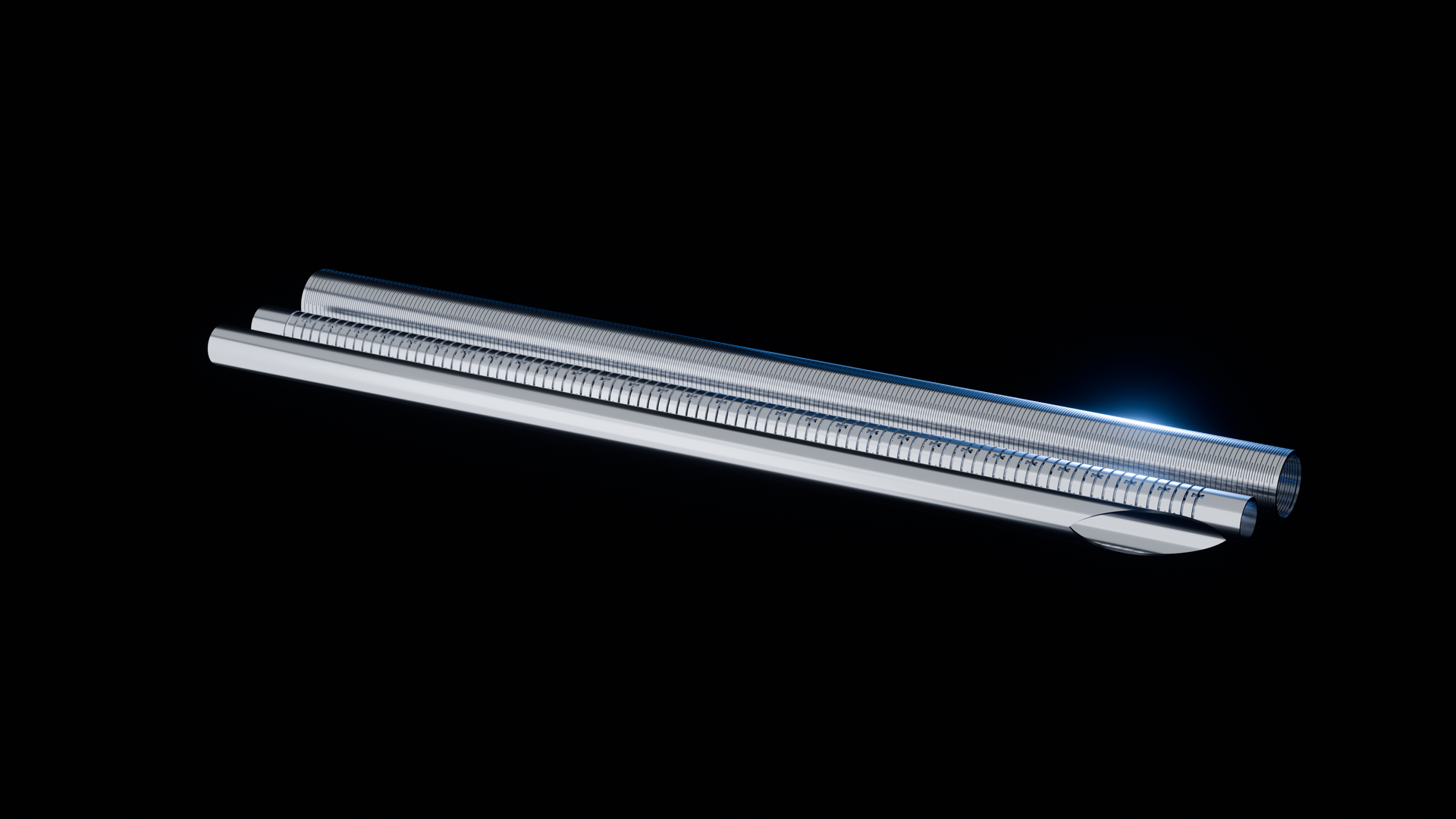
A braided shaft takes weeks to change: new
mandrel, new braid schedule, new reflow. A laser-cut hypotube changes in a program
edit. Used with a stock catalog, that turns shaft development into a loop measured
in days. This is the loop as we run it with customers.
Stratos Laser Engineering · 4 September 2026 · 5 min
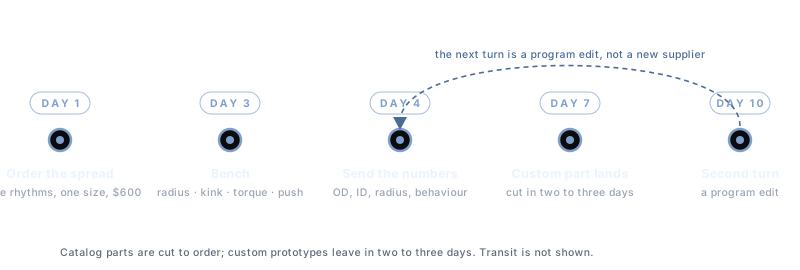
The loop. Catalog parts to learn the pattern, a custom cut to hit the number, and a program edit for the next turn.
Day one: order the spread
Pick the size the device needs and order the three interrupted-spiral rhythms at
one pitch from the catalog: 120° cut at 2.5 CPR, 80°
at 3.5, 65° at 4.5. Three parts, $600, 6 in each, with a print and a 3D model on
every page. If the tightest radius is the unknown, order one rhythm at three pitches
instead. Every one of the 29 catalog ODs from 0.014 in to 0.353 in carries the same
three rhythms, so the spread exists for whatever size you are at.
Day three: bench
Four measurements decide a shaft, and all four come off a 6 in shorty.
Measure
How
What it tells you
Bend radius
wrap round pins of decreasing diameter until the slots close
the pitch and rhythm to keep
Kink
bend past that point; does it come back
whether 304 holds or the section wants nitinol
Torque
clamp one end, protractor on the other, read the lag at a fixed torque
how much uncut the steering section needs
Push
tip against a load cell, push the hub
whether the pitch is too short for the support section
Do it for all three rhythms and the direction of the next cut is on the bench in
front of you.
Day four: send the numbers
The custom cut does not need a drawing. It needs the numbers the part has to
hit: OD and ID, the bend radius you measured or the one you want, which way the
shaft should behave (maximum flexibility, balanced, stiff, or variable from tip to
base), and anything else that matters, from kink resistance to radiopacity.
The requirements form asks for exactly those, and our
engineers design the geometry from them. If the shaft wants two behaviours along
its length, a dogbone deflection zone running into an interrupted spiral, say so;
that is one program, not two parts.
Day seven: the custom part
Prototypes leave in two to three days, programmed and cut on the same floor by
the people who wrote the pattern. That puts a custom-cut shaft on your bench within
the week you ordered the catalog spread, and a second custom turn before the
following weekend. Two design turns a week is the normal cadence, with a program
library of more than 8,500 cuts behind every new one.
What stays constant
Every part, catalog or custom, is cut with the same 0.001 in kerf to the same
±0.0002 in standing tolerance on the same ISO 13485 floor, and every lot is
traceable to its heat with a certificate of conformance on request. The prototype
you bench and the production part you validate are the same program; the number
in the order field is what changes.
What to know before you order
Catalog parts ship as cut: not cleaned, passivated or sterile unless the product
page says so, with ASTM A380 cleaning and A967 passivation available as finishing
steps. They are 304 stainless. The modelled bend radius on each page is engineering
guidance, marked experimental, and the bench is the decision. And we sell
components: the device, its validation and its clearance are yours.
Start the loop
A 4F spread to begin with: SL-026560,
SL-026570 and SL-026580,
0.050 in OD × 0.045 in ID, the three rhythms at 0.005 in pitch.