Two alloys cover nearly every laser-cut hypotube:
304 stainless steel and nitinol. They cut to the same patterns and they behave
nothing alike. The choice comes down to four numbers and one question about where
the shaft is going.
Stratos Laser Engineering · 4 September 2026 · 6 min
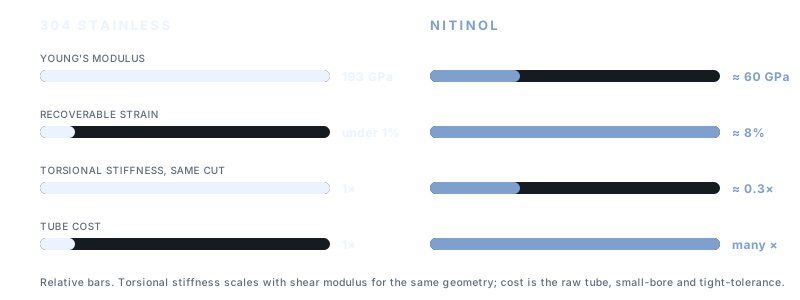
Four numbers. Stainless wins stiffness and torque per degree; nitinol wins recoverable strain; the tube cost is not close.
Modulus
304 stainless has a Young's modulus near 193 GPa. Austenitic nitinol sits around
40 to 75 GPa depending on composition and temperature, with a plateau in its
stress-strain curve that stainless does not have. For the same tube and the same
cut pattern, the stainless part is roughly three times stiffer in bending and in
torsion. That is the whole story of pushability and torque response: a 304 shaft
carries a hub rotation to the tip with less twist, and it pushes with less column
buckling. The interrupted spiral is designed around that stiffness; the pattern
supplies the flex and the alloy supplies the torque.
Recoverable strain
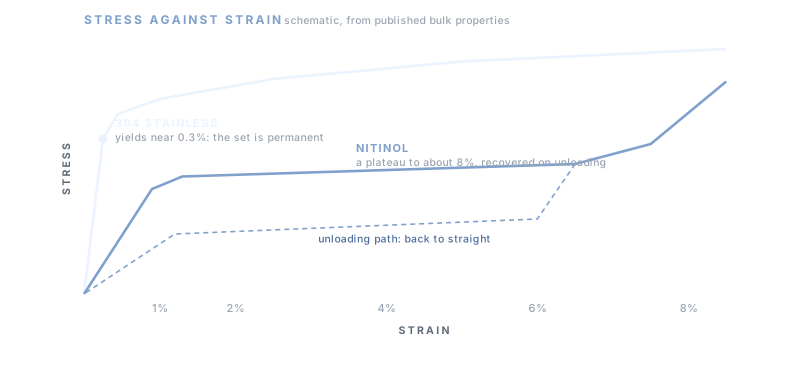
Stress against strain, schematic. Past its yield a 304 bridge stays bent. Along its plateau a nitinol bridge comes back straight when the load is removed.
Stainless yields at well under 1% strain. Superelastic nitinol recovers up to
about 8% through a reversible phase change. In a shaft, that is kink behaviour.
Bend a 304 hypotube past the radius its pattern allows and the bridges take a
permanent set; the tube stays bent. Bend a nitinol hypotube to the same point and
it springs back straight. A nitinol shaft can be forced through a bend a third to
a tenth of the radius that would kink the same stainless shaft and come out
unharmed. Where a device will be driven round the ophthalmic or into the M2 and
pulled back through the same turn, that recovery is worth every other trade.
Torque per degree
Torque is where nitinol gives the most back. Because its modulus is lower and
its stress plateau caps the load it carries at strain, the twist between hub and
tip for a given torque is several times that of stainless in the same geometry.
Some of that is recovered by design: a stiffer rhythm, more uncut degrees, a longer
pitch. Some of it is not, and a nitinol shaft that must steer needs its pattern set
for torque from the start. On a 304 shaft the pattern can be set for flex and the
torque comes for free.
Cost and stock
Nitinol tube costs many times what 304 hypodermic tubing costs, and
tight-tolerance small-bore nitinol tube is a mill order with a lead time. 304
hypodermic tubing is a stocked commodity in every gauge from 6G to 34G, ASTM A908,
with heat-lot certs. That is why our 262 catalog
hypotubes are all 304: the tube is on the shelf, the program is proven, and a
$200 part can ship in days instead of after a mill delivery. It is also why the
raw tubing we sell by the stick is 304.
Under the laser
Both alloys cut with the same 0.001 in kerf. Nitinol is cut under an inert
assist gas and with its own power settings, and it is more sensitive to the
heat-affected zone at the slot edges, which is why nitinol parts more often go on
to electropolishing. A 304 part is cut under oxygen assist and is usually finished
by deburring and passivation to ASTM A967. Neither is a difficulty; they are two
programs.
Where each one goes
304 stainless for the shaft that has to steer, push and hold its torque:
proximal and mid shafts, delivery systems, guide and support catheters, and any
prototype where the pattern is still being found. Nitinol for the segment that
will be forced through the tightest anatomy and must come back straight, and for
shafts whose whole job is to track. Many finished devices use both, joined along
the length: a 304 proximal shaft for the torque and a nitinol distal section for
the recovery.
Stock first, then the alloy
Find the pattern on 304 catalog parts, which ship in days. Once the rhythm and
pitch are right, a nitinol version of the same geometry is a quoted custom cut,
in 304, 316, 303 or 17-7 stainless, nitinol or platinum-iridium.