
Help
LASER-CUT HYPOTUBE FAQ
The questions catheter and delivery-system engineers ask before they buy, answered from the same numbers the store runs on. Anything not covered: sales@stratoslaser.com.
Help
The questions catheter and delivery-system engineers ask before they buy, answered from the same numbers the store runs on. Anything not covered: sales@stratoslaser.com.
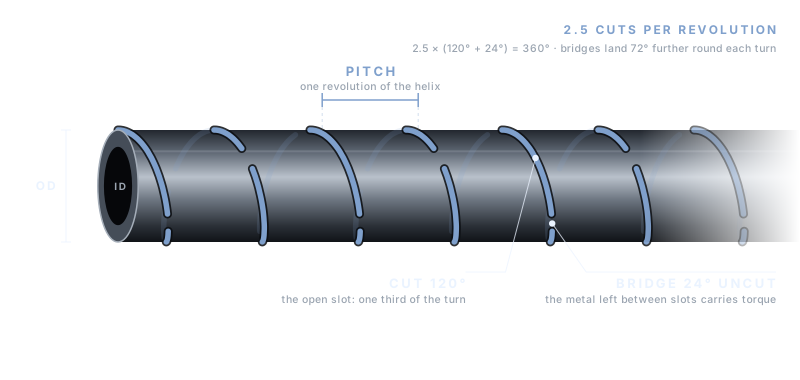
A hypotube is a thin-walled metal tube, most often 304 stainless steel, used as the shaft of a catheter or delivery system. Laser cutting a pattern of slots into its wall turns a stiff tube into a shaft that bends where you want it to and still carries torque and push. The pattern sets the mechanics: flexibility, kink resistance, torque response and pushability all come from the geometry of the cut.
A helical cut around the tube that stops and starts on each turn, so the tube stays one piece. Three numbers define it. Pitch is the axial distance the cut advances per revolution. Degree cut / degree uncut is how much of each revolution is slotted and how much is left as a bridge. CPR (cuts per revolution) is how many of those cut and bridge pairs fit in one turn. Shorter pitch and larger cut angle make the tube more flexible; more uncut material makes it stiffer and better at carrying torque. Every catalog part lists all three.
Tube OD from 0.009 in to 0.750 in, walls from 0.001 in, lengths to 6 ft. The catalog covers 1F to 27F in 6 in shorties and full-length tubes. The finest feature we have cut is 11.5 µm.
Every catalog hypotube and pull ring is 304 stainless steel, and the material is stated on each product page. For custom work we quote 304, 316, 303 and 17-7 stainless, nitinol and platinum-iridium; ask with your requirements. When each alloy fits is its own article.
Most catalog parts sell from a single piece. Where a part carries a minimum, the product page says so next to the price. Raw tubing is sold by the stick. Custom work is quoted per job.
Prototypes leave in two to three days, programmed and cut on the same floor. Catalog parts are cut to the published specification when you order; we confirm the ship date when we confirm the order, and shipping estimates start from that confirmation.
Our standing tolerance is ±0.0002 in, with a 0.001 in kerf. Each product is sold to the specification published on its page: OD, ID, wall, length, cut pattern and material. Figures the site marks experimental, such as the modelled minimum bend radius, are engineering guidance rather than part of the specification.
A certificate of conformance is available for any lot on request, and every lot is traceable back to its heat. Material certifications, inspection reports and first-article inspection can be quoted separately; ask before ordering, because they affect price and lead time.
Catalog parts ship as cut unless the product page says otherwise. They are not cleaned, passivated, sterile or pyrogen-free by default. ASTM A380 cleaning and ASTM A967 passivation are available as finishing steps on request, along with deburring, electropolishing and coatings. Cleaning and sterilization validation for a device is the device manufacturer's responsibility.
Yes. Send a drawing, or just the numbers the part has to hit: bend radius, stiffness, torque response, OD and ID. Our engineers design the geometry and write the cutting program. Use the requirements form on the home page or write to sales@stratoslaser.com. Custom work is quoted separately from the store.
No. We sell components. Nothing in the store is cleared, approved or registered for clinical use, and if you build our parts into a device you are the device manufacturer, responsible for design controls, biocompatibility, validation and regulatory clearance.
Every product page has an interactive 3D model of the cut pattern and an engineering print you can open as a PDF. The model shows catalog geometry, not the individual lot you receive.
Card and ACH bank transfer at checkout, through our payment processor; we never see your card or bank numbers. Prices are in US dollars and exclude sales tax and freight. Sales tax is calculated from the ship-to address; send a California resale or exemption certificate before we invoice if you hold one. Freight is billed at the carrier's actual rate, or to your own carrier account, with no markup. Net 30 terms are available subject to credit approval.
Catalog parts can be returned within 30 days. Parts that arrive damaged, short or out of specification are our problem to fix at our cost; tell us within 15 days of delivery, quoting the order number and the lot number on the package, and do not return anything without an RMA number. The full Returns policy has the details.
Davis, California, one floor under an ISO 13485 quality system. Every cutting program that runs here was written in this building.
Write to the people who write the cutting programs.